Why drone use needed separate approval
Every pesticide sold in India is registered with the Central Insecticides Board and Registration Committee (CIB&RC) for specific crops, doses and application methods, and until recently those methods meant knapsack or tractor sprayers. Drones apply the same product at a fraction of the water volume, so the dose per litre is much higher, the droplets are finer and drift behaves differently. That required either fresh registration data for each product, which takes years, or an interim route.
In 2023 the Ministry of Agriculture and Farmers Welfare took the interim route. It granted a two-year interim approval for the application of several hundred already-registered pesticide formulations by drone, following the standard operating procedure for drone spraying, and has extended that approval since. The published list runs to roughly 477 formulations: insecticides, fungicides and plant growth regulators, both single-active and combination products.
What the interim approval covers
- Insecticides, fungicides and plant growth regulators that were already registered for the crop, used at the registered dose per hectare
- Application by a type-certified drone flown by a certified pilot following the crop-specific SOP
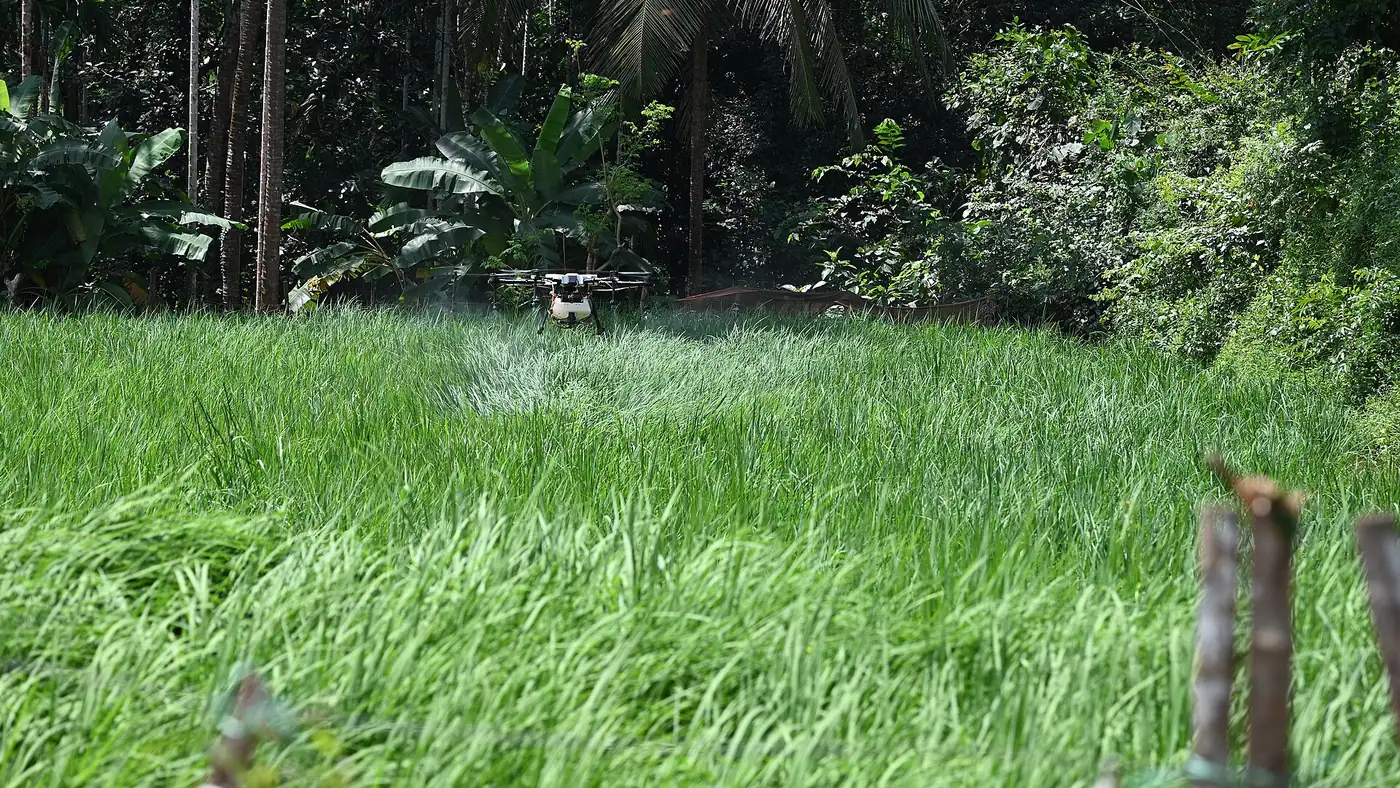
- Spray volume, height and droplet size as set in the SOP for the crop, typically around 10 litres of mix per acre at 2 to 3 metres above the canopy
The interim list is not a permanent registration. Manufacturers are expected to generate drone-specific data and register products for drone use properly; as they do, products move from the interim list to full label approval with drone-specific directions.
What is not covered
- Most herbicides. Weedicides were largely left off the interim list because of drift risk to neighbouring crops. Some have since been registered for drone use with specific conditions; treat each product individually and ask your operator.
- Products the label restricts to particular methods, such as soil drenches, seed treatments or granules
- Any product on a crop it is not registered for, even if it is on the drone list for another crop
- Mixing several products in one tank beyond what the labels allow
How to check a product before spraying
- Look for drone application on the label or leaflet; newer batches of approved products carry it
- Search the CIB&RC list of formulations approved for drone application (published by the Directorate of Plant Protection, Quarantine and Storage) for the product name and formulation, such as "Chlorantraniliprole 18.5% SC"
- Ask the operator. Sky Spray operators are trained on the SOP and will decline products that are not approved for drone use, so mention the product when you book
- Keep the label dose per acre; the operator sets the drone's flow rate to match
Nano urea and foliar nutrients
Fertilisers such as nano urea and nano DAP are not pesticides and are not on the CIB&RC list; they are regulated under the Fertiliser Control Order and are explicitly promoted for drone application. Most foliar micronutrient products likewise do not need CIB&RC approval. The operator still follows the SOP for flight height and volume.
Sources
- Directorate of Plant Protection, Quarantine and Storage (CIB&RC)
- Ministry of Agriculture: interim approval of pesticides for drone application (press coverage)
- Standard operating procedure for drone application of pesticides (Ministry of Agriculture)
Scheme amounts, approved lists and rules change. This guide was last revised on 2026-09-26; check the official source before acting on a figure.