
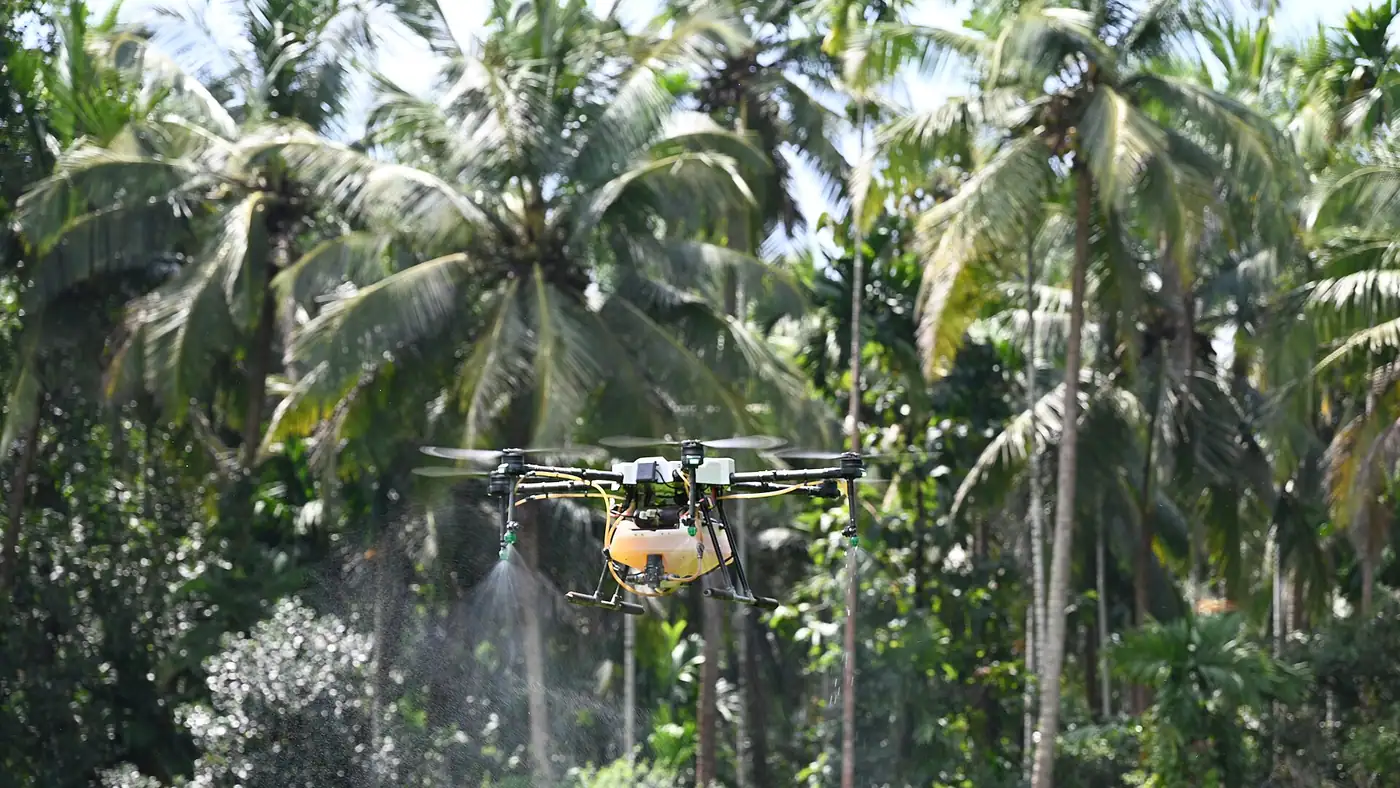
Two central schemes fund agri drones
Agricultural drone purchases in India are subsidised through two central schemes. The Sub-Mission on Agricultural Mechanization (SMAM), the "Kisan Drone" component, gives tiered grants to individual farmers, farmer groups, custom hiring centres and institutions. Namo Drone Didi, a separate central sector scheme, gives women self-help groups a much higher subsidy to run drone-spraying as a rental business.
Both schemes fund the purchase of a type-certified drone and its accessories, not the cost of getting a field sprayed. If you are a farmer who wants your crop sprayed, you do not need either scheme: you book an operator who already owns a drone, often one bought under these very schemes.
SMAM Kisan Drone: subsidy by who is buying
The grant is a percentage of the drone cost, capped at a rupee ceiling. Caps have been revised more than once, so confirm the current figure with your state agriculture department before you plan finances.
| Buyer | Subsidy | Notes |
|---|---|---|
| Farmer producer organisations (FPOs) | Up to 75% | For demonstrations on members' fields |
| SC/ST, small and marginal, women and North-East farmers | 50% | Capped (₹5 lakh under the original 2022 guideline; check the current ceiling) |
| Other individual farmers | 40% | Capped (₹4 lakh under the original guideline) |
| Custom hiring centres run by cooperatives, FPOs or rural entrepreneurs | 40% | To offer spraying as a service |
| Custom hiring centres run by agriculture graduates | 50% | Capped at a higher ceiling than other CHCs |
| ICAR institutes, KVKs and state agricultural universities | 100% | For demonstration, training and research |
Funds are released to state governments, which run the applications through their agriculture departments and DBT (direct benefit transfer) portals. Several states add their own top-up or run parallel schemes, so the effective subsidy in your state may be higher than the central figure.
Namo Drone Didi: 80% for women self-help groups
Namo Drone Didi provides drones to 15,000 women self-help groups over 2024-25 and 2025-26 so they can rent out spraying services to farmers. The central assistance is 80% of the cost of the drone and accessories, up to ₹8 lakh, with the balance available as a loan under the Agriculture Infrastructure Fund at a 3% interest subvention.
One member of each group is trained as a drone pilot (a 15-day course leading to the DGCA Remote Pilot Certificate) and another as an assistant for maintenance and support. The scheme expects each group to earn at least ₹1 lakh a year from rental spraying. Groups are selected through the state rural livelihood missions, not by direct application.
What you need before applying
- A type-certified agricultural drone from the DGCA-approved list, registered on Digital Sky with a UIN (unique identification number)
- At least one operator holding a DGCA Remote Pilot Certificate for the drone class (small or medium category)
- Proof of agricultural land or, for CHCs and FPOs, registration documents and a bank account for DBT
- Insurance for the aircraft, and a quotation from the drone manufacturer or dealer
- For Namo Drone Didi: membership of an SHG registered with the state rural livelihood mission
Should a farmer buy a drone at all?
A 10-litre spraying drone with batteries, charger and a generator costs several lakh rupees even after subsidy, needs a certified pilot, and only pays for itself when it flies most days of the season. For a farmer with a few acres, the arithmetic rarely works: a season of booked sprays costs a fraction of the loan instalment.
Where buying does make sense is as a business: an FPO or an individual with a Remote Pilot Certificate who sprays for the whole village at a per-acre rate. That is exactly the operator side of Sky Spray, and the app sends those operators paid jobs from farms around them.
Sources
- PIB: Funds for Kisan Drones (Ministry of Agriculture and Farmers Welfare)
- PIB: Namo Drone Didi scheme
- Ministry of Agriculture: SMAM guidelines (agrimachinery.nic.in)
Scheme amounts, approved lists and rules change. This guide was last revised on 2026-09-26; check the official source before acting on a figure.